Showing posts with label hand pain. Show all posts

Monday, June 3, 2013

Aluminum vs Steel: A Test with the Trek Lexa SLX

Last summer, I wrote up some thoughts on my personal preferences and experience while testing out a carbon road bike. I admitted up front that I am a lover of steel, but I wanted to see and feel the differences for myself and what I could be missing out on. More recently, I've been frustrated with what I'm able to find in a steel road bike - more specifically, that I cannot find something that fits well and is lighter/faster (and, of course, somewhat affordable). We've tried building up our own versions a few times, but it just hasn't gone well at all. Ultimately, I don't want to spend all the "good weather" months hunting down a bike. I want to spend the time riding my bike.

The idea was to go and try out a bunch of road bikes in shops. I was going to leave all my pre-conceived notions about what a road bike should be, what I like and don't like, and what material the bike should be made of at home. That was a little tough for me, but I was willing to play along to see what sort of bike could be best for me.  We found a really great sales guy (actually the assistant manager) at a bike shop and after a quick chat about what I'm currently riding, what I like and don't like, he suggested a bike for me to try: a Trek Lexa SLX. It was not a Trek-specific shop, so I didn't feel as though there would be any pre-determined idea on the part of the shop-boys (and girls) as to what I should try. My immediate issue with this pick was the fact that it's an aluminum frame. As with my test ride of carbon, I have nothing specifically against aluminum, but I've had aluminum bikes in the past and they have caused incredible pain - so much so that I had sworn off aluminum bikes for any future potential bike purchase.
*Image from Trek
I reminded myself, however, that I was keeping an open mind. The assistant manager told me he has severe hand/wrist issues and he can ride the aluminum just fine because of the carbon fork. He explained how the aluminum tubes Trek now makes have changed and off I went on a test ride. Sam's first comment was, "Woah! You just got on and went... crazy!" He was referring to the reality that typically when I get on a new-to-me bike the first time, I'm always a little hesitant. It didn't happen with this bike. Score 1 for aluminum. After riding in a circle to test out positioning, Sam joined me on a ride to see what I could do on this bike.

Immediately, I was impressed with the positioning. I didn't feel overly leaned forward, nor did I feel too upright. The handlebars seemed unbelievable perfect, and I loved the gearing on the bike too. The only complaint I had was the saddle (but that's to be expected on a short test ride). Sam claimed he was having to push to keep up with me (I don't know how true that was, but I felt fast enough, so I was satisfied). We switched bikes at one point so Sam could get a feel of it, and then rode back to the shop.  All had gone well, but I had the nagging of my past experiences with aluminum poking me - though just a bit.

We walked away from the shop to take a look at some other things, but ultimately came back. We were assured that we had 30 days to test out the bike on my own and if it didn't work, we could bring it back. I liked the fast feeling, I liked the positioning, so it was hard to not take him up on the offer. After some idle chatter, we decided to take it home. After bringing the bike home with us, I took it on a few rides: one with Sam along so that we could make adjustments as needed "on the fly," and two others on my own.

I was on a buyer's-high, for sure. I couldn't believe how fast I felt on this bike, and was excited to get out on the road. We tried out one of my already-owned saddles on the first half of the ride and then switched to another. It was a great way to feel immediately which one was working better. After the saddle change on ride one, all was going well. My hand and wrist were giving me a bit of a problem, but I assumed it was due to over working them over the prior several days. Not a big deal, I thought. I would carry on.

The second ride, I went on alone. My hands were still bothering me, but because the days were back to back and I was already experiencing the pain, I assumed that it was just something that needed to heal over a period of time. The ride was fairly short (under 15 miles), but my hands weren't doing great and I was tired, so I decided to head home early.

The last of the three rides, I set out with the intention of going on at least a 35-40 mile ride. I'd purposefully given myself a couple of days to recover from the over-use of my hands the prior week, so I thought this would be a better indicator of how the bike was working for me. This bike wasn't purchased for purposes of longer distance riding, but I wanted to know that it would make it through a solid ride, and I didn't think that 35 miles was an unreasonable distance to expect out of a faster, lighter bicycle. At about 4 miles into the ride, my "bad" hand was in extreme pain and going numb. My other hand was also having some buzzing sensations through it, but I could tolerate the uncomfortable feelings on that side. I stopped early on to shake out my hands, thinking that I might just need a quick break, however, the pain and numbness continued to increase the longer I rode. By mile 12, I had pain shooting up through my entire arm, to the base of my shoulder on the bad side. The oddest feeling to me on this ride is that I was entirely comfortable with the positioning, the set-up, the saddle - everything was great, except for the pain in my hand/arm. The problem was (and is), I can't be in that much pain every time I want to ride.

By mile 18, I didn't think I would make it home without a rescue phone call, but because my body was comfortable, I figured I would do my best to keep my hand off the bars and make it home. At just under 30 miles for the ride, I was in severe hand and arm pain when I returned the bike to its spot in the corral. I was so upset that I sent an e-mail to Sam telling him that I really didn't think I could keep this bike. I told him I was enjoying it, but my hand just couldn't stand all the pain. That pain continued on for several days, during which I elected not to ride this bike again.

During that same few days, Sam was doing research, attempting to understand why this bike was causing me so much pain - and in just one specific area. I had my own ideas of what was going on - more specifically, that the aluminum frame was causing this mystery pain. Sam's conclusion was a bit different. From the research he had completed, he believed it was the tires on the bike. Lucky for him, I'd already ordered a set of tires (God help me with my white/cream tire obsession!). He postulated that it was both the tire itself and the tire pressure. During the next ride, I would try taking the tires down to around 90 PSI (I'd been riding at 110-115 PSI) to see if that would help.
Trek Lexa SLX with Schwalbe Durano tires
Goodness knows I wasn't exactly looking forward to testing out this theory. After spending several days in pain, I really didn't want the experiment to fail. The first reason being that I really like the bike. While it's not the "look" I would naturally be drawn to, it is comfortable and easy for me to ride. Never in my life have I had such ease when getting on a road bike. I wasn't willing to give up without a fight, so I tried to patiently wait for the arrival of my new tires. Patience is not a virtue of mine, but because it coincided with illness, I was able to wait out the new Schwalbe tires.

The day I set out, I was still recovering from being ill. I felt okay, but was still hacking like I smoke 2-packs a day. In addition, the wind was not my friend. We had a storm rolling in and that always makes for a challenging westward ride here at the base of the Rockies. My intention was to do the exact same ride I had done the week prior, but unfortunately, the wind was making it overly challenging. Instead I opted to do a loop that was close to home so I could come back as/if needed. Unfortunately, even with the new tires, things still weren't going well. Again, early on (just shy of mile 5), the bad hand was going numb and I was starting to experience pain again. The left hand that had experienced a small amount of buzzing during the prior rides seemed to be doing better, however.
I ended up finishing the ride at just under 15 miles because the wind was making everything more brutal than it should have been. By the time I was done, I was experiencing the same pain I had been on the prior rides. Angered by this reality, Sam was determined to figure out why a bike that fits so well was continuing to cause so much pain in just this one area of the body. He contacted the bike shop to see if there was something we should try before we gave up entirely on the bike.

Their recommendation was to lower the handlebars. This always seems a bit odd to me as one would think this would put more pressure on an already bad spot, but I was willing to give it a try because I just didn't want to give up. Sam lowered the bars and I took it on a 3 mile ride just to be sure I could handle it. Things seemed fine, so the following day, I set out on a slightly longer, short-ride to see if my hand experienced the same pain. Just before mile 5, I was expecting to experience the start of the numbness, but it didn't happen. I thought it was odd, but carried on.

Around mile 8, I started to feel some numbness sneaking in, but over 10 miles (a short ride, certainly), there wasn't the extreme pain that had taken place on the prior rides, though I was still getting similar sensations. Could that have actually worked? The only way to know for sure would be to take it out on a longer 20-30 mile ride - which I wasn't exactly excited about, knowing the history of what had happened on the bike.

A couple of days later, Sam and I set out together to do a longer ride. We planned to take our time, stop and make little adjustments to see if it would change anything as we went along. While it was a bit of a nuisance to stop every couple of miles, it seemed like the only reasonable thing to do. We'd stop and adjust one thing at a time and then carry on. We lowered the bars, and lowered them more - then raised them back up. We shifted the saddle back and forth, and tilted it up and down. We moved the brake levers in a bit, and tilted the entire handlebar up and down. By the time we'd finished the 25 mile ride, things felt about the same as when we'd started bike-wise, but my hand was feeling the effects of all of the changes for sure.
(left) Rivendell A. Homer Hilsen, (right) Trek Lexa SLX
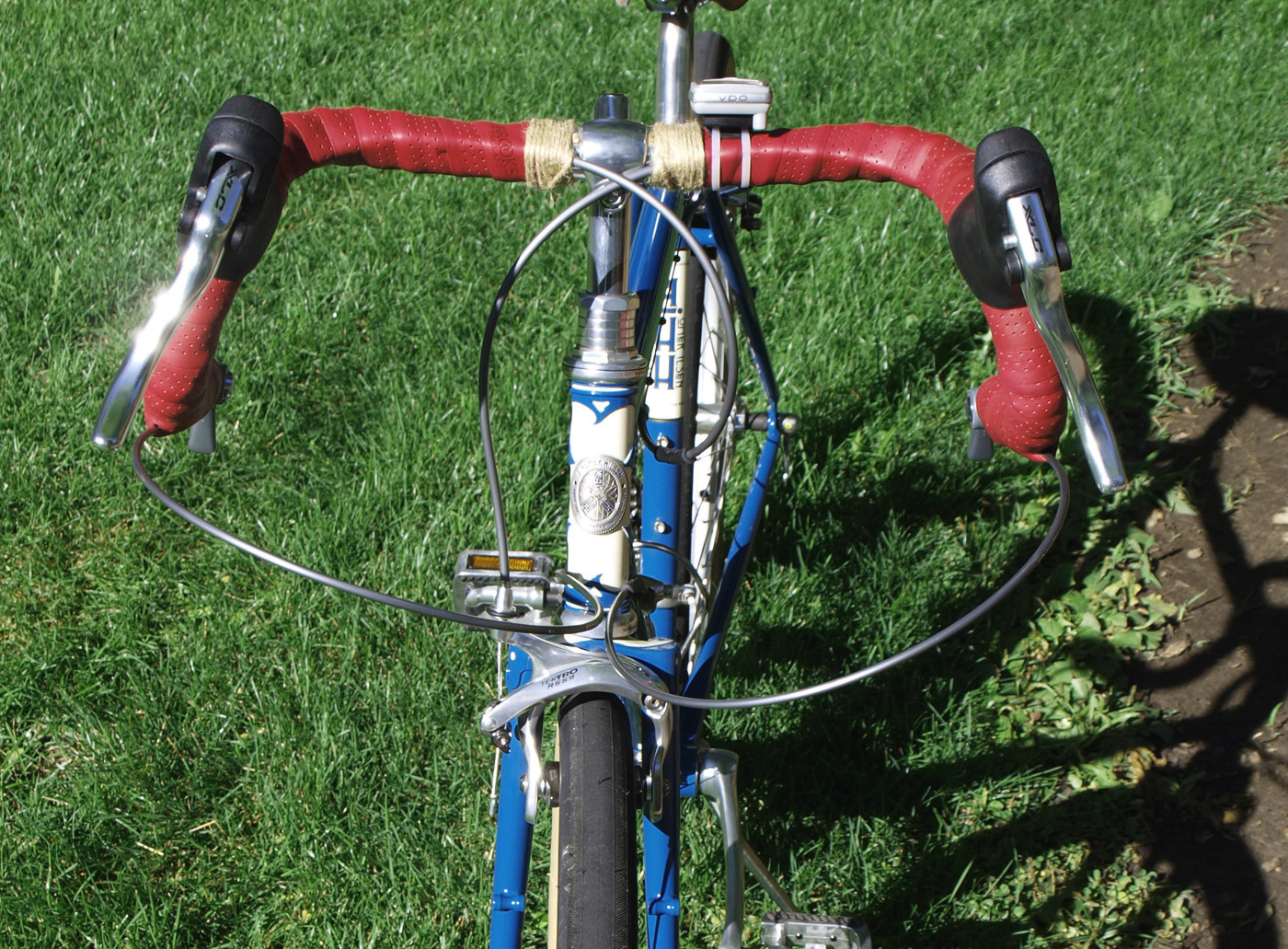
Undeterred, Sam suggested pulling out the Rivendell and having me ride each bike up and down the street to take a photo to see if there was a significant difference in positioning. When lining the bikes up next to each other, everything seemed to be at similar heights and angles, and even though the geometry of each bike is different, the handlebars were set at almost the same spot, as were the saddles. The photos are blurry and hard to really see, but it is visible that there is more pressure being placed on my hands on the Trek, and I have a bit more of an elbow bend on the Rivendell.

Really, this just confused me more because I am entirely comfortable on the Trek, except for the one hand/arm that refuses to cooperate. At this point, the plan is to try yet again by raising the handlebars back up to their highest point, and tilting the saddle up to see if it will force me to put more weight on my back side, rather than on my hands. If that doesn't work, I'm at a loss as far as what to make of all of this. I've read enough to know that many people believe the frame material in this day doesn't really matter. Many believe it's simply more important to find a geometry and set up that works for the rider. I don't know if the damage to my hand and wrist is just so much worse on one side that there is no fix on the bike. Yet, I still think about the reality that I can ride my steel bike without issue. Is it the weight of the bike? Perhaps it's simply too light and forcing my body to absorb too much of the road, and the frame material wouldn't change any of it. The bike isn't that light, but it's significantly lighter than the Rivendell, and definitely zippier.

Although we are still taking a few days to fiddle with things to see if we can get it to work, I don't have the highest expectations of getting the Trek to work for me - which is a shame because I've actually grown fond of it - or at least the speed - despite the pain. I'm frustrated because I would like to be able to ride a bit faster on some rides, but I just can't quite figure out what to do to get this bike to work with me instead of against me. There's a part of me that thinks I just wasn't meant to have a faster bike, and a part of me that wants to fight to the very end, attempting to find a solution. Ultimately, as stated from the get-go, I just want to ride, and spending the summer worrying about pain on any bike isn't exactly what I had in mind. Hopefully, the solution is just around the corner, but until then, I carry on with the heavier steel bikes. If nothing else, at least I'm comfortable.

*Edit:  After this post, I completed a century ride on the Trek, so we have definitely been able to resolve the issues I was having. In the end, it was just minor tweaks that helped fix the pains in my hand/arm, but patience was definitely needed to get to that point.

Monday, September 3, 2012

Re-Learning What I Thought I Knew: I CAN Ride Drop Bars!

In the summer of 2009, my darling Sam picked up a road bike for me from a Craigslist ad. At the time, I had been riding upright/city style bikes and enjoying my slow pace around town. When I started daydreaming about long rides for exercise, touring, and so on, Sam decided to take matters into his own hands and found me a mid-70s Raleigh Super Course to try out, rather than spending hundreds or even thousands on something that, potentially, I may not have ever touched. When he brought it home my initial reaction was split: I was thrilled at the opportunity to ride a road bike (I hadn't been on one since childhood), but I was terrified of the position on the bike and the handlebars. Surprisingly, things went pretty well... except, that is, for the drop bars.

The bike was large for me, so we chucked it up to sizing issues and moved on down the road to the next choice. Even though the bike that followed was sized properly for me, I just couldn't seem to make any kind of drop bar work. I tried a variety of them, but every time I would be in so much pain, that I'd end up not riding for a week or more. I had tried classic style (code: old) drop bars, noodle bars, randonneur bars, but nothing seemed to help me find a position that worked. Ultimately, I gave up on the idea and just started looking for an alternative. The one that worked best for me was the albatross handlebar, and so, for the last couple of years, that has been my go-to choice for any bicycle - even road bikes. I've done just fine with them and travelled well enough that I came to the realization that every bike I'd ever own would have these bars. I even have a "spare" set -"just in case." Sick, I know.
The "usual" bicycle for long or organized rides
Still, I couldn't help but have some drop bar envy when I'd see folks pedaling by. In reality, there are simply more hand positions on this type of handlebar, and knowing that I do have hand/wrist issues to contend with, I stubbornly kept trying to make some kind of drop bar work for me. After each attempt and subsequent failure, I would return the set up to the albatross bar and let out a huge sigh. "I guess this is just what I'm destined to ride," I'd constantly try to reassure myself. I had switched out the handlebars on the newer Homer bicycle at least half a dozen times, convinced that I could make the drop bars happen. With my last attempt I told Sam, "Let's just put them on and leave them for an extended period of time and see what happens. I'll start riding them on short trips and just see if it's all in my head, or if there's some possible way to make these work." And so, we did. We set up the Homer with the randonneur bars, and I figured I'd slowly allow myself to try them out without the pressure of having to do a long distance ride.
Ah, but fate had other plans. The evening before my recent Venus de Miles ride, we had an incident with the Hillborne which left me without a saddle/seatpost. As we desperately tried to figure out how to resolve the problem so late on the eve prior to the ride, Sam and I looked at each other already knowing what this meant: I'd be riding the dreaded drop bars on an unfamiliar bike for the 51 mile ride the following morning.

"I'm a big girl," I said, trying to reassure the slightly-flustered Sam that I would manage this on a bike I wasn't completely used to riding. "It will all be okay, I promise." After having joked just days prior that this would happen, I honestly didn't expect it to actually be coming about (talk about speaking things into existence). Frankly, I was terrified that I would get 10-15 miles in to the ride and not be able to finish because of hand pain, but I wasn't about to worry Sam with such thoughts. We took a few minutes and did our best to get the Homer set up in a manner that would keep me as comfortable as possible, and while doing so, the handlebar stem was dropped significantly lower than it had been. I took it for a quick ride down the street and said, "Well, I think it's as good as it's going to get with the time we have."
In the morning, we agreed that Sam would come out and meet me at or near the first refill station/rest stop in case there were any problems.  When he arrived to meet up about 11 miles into the ride, I was doing great. "My hands don't hurt at all," I proclaimed with glee. "We'll see what happens as time wears on, but I'm really doing fine." We were both in a bit of shock knowing my history with this type of handlebar, but I wasn't going to fight it. We decided to meet up again close to the half way point, and off I went to continue the ride.

To make a long story short(er), I made it to the end of the ride (including the ride to and from the starting/ending point) and I wasn't dying or in extreme pain. There was a bit of fatigue, though that was to be expected as it was a longer distance than I typically ride, but I survived and even rode again the following day and rest of the week.
Perplexed by all of this, we attempted to figure out what had changed about the set up, but the only item we could definitively point to was the act of lowering the handlebar stem. While this had always seemed counter-intuitive to me (to lower the stem, thus putting greater pressure on my hands), it actually had the opposite effect. Rather than making the ride more painful, it actually made it easier and more pleasant. When I rode, I used my core muscles more frequently, which kept a great deal of the weight off of my hands. The stem is still high by roadie standards (it currently sits just a tad higher than the saddle), but lowering it seems to have solved the problems I was experiencing with drop bars in the past. The lesson? I'm not entirely sure, but I believe continuing to experiment and try different ways of setting up a bike is important. I may have driven poor Sam absolutely batty with my constant requests to change handlebars, stems, etc, but in the end, I think we've managed to find a way to make this set up work.

Thursday, September 8, 2011

{Part 2} The Surly Pacer: Modifications to Make it Work

The ongoing saga of the Surly Pacer set up continues, and I am finding that I do enjoy riding this bike. The changes that have taken place are definitely helping with comfort and (hopefully) with the longevity of this bike in our household. After writing about round one mods on the Pacer, I figure it's a good point to check in again.
Since the last post, the first thing to get switched out were the handlebars. While I continue to attempt to make drop bars work for me (in various forms, on different bikes), I believe that it is very near impossible for me to find comfort with any model of drops for rides longer than 10 miles or so. I am at a loss as to the why's of this, and I wish there was something scientific or even specific that I could point to as to the reason they don't work, but every time I try, it seems to be unsuccessful in the long term. So, rather than fight with it on the Pacer, I decided that a switch out to the Albatross bars might be the answer.
Somewhat surprisingly, these handlebars do seem to work well. I've been on a couple of longer rides with them and I don't return with aching hands or numb fingers. Stylistically, I think it makes the Pacer look more like a cafe racer type of bicycle than a road bike, but I've never really been one to follow the rules very well, so why should my road bike set up be any different? I have these mounted in the "unconventional" manner (flipped upside down), and it seems to work well.
The other change that has taken place is the saddle. I had mentioned that the temporary Public Bikes saddle was working in the short term, but that it wasn't a long term solution. The main reason for this is that after any sort of distance over 18-20 miles, I begin to go numb in the rear. It doesn't seem to matter if I rise up out of the saddle for a bit or not, the squishier saddle just doesn't work for long rides for my bum. I'm currently trying out a Brooks B-17 Select. While I am a Brooks fan, I have to admit that the leather on this model seems to be supremely hard (I actually knocked on it while we were adjusting it and it sounded like a woodpecker in a tree). I've never experienced this extreme on any of the wider saddles (the B-72, B-67, B-18, or B-66), so I'm prepping myself to deal with a lengthy break in process so many Brooks riders bemoan. I've proofided it up to make it as pain-free as possible, but I have a feeling that I'm in for a rocky few hundred miles (at minimum, I'm sure) to get it to a more comfortable place.
For now, these changes seem to be adequate to make the bike ride-able and comfortable. While "adequate" isn't really the word I'd like to be using, until I have more time to ride some distance, I'll refrain from shouting from the mountain tops about the glorious set up of this bike (though I do find it to be interesting and unique). As with all modifications, one change can sometimes create other issues, so I'm somewhat wary of the outcome. Stay tuned!

**A few more photos of the Pacer's set up can be found here, if interested.

Tuesday, August 30, 2011

{Part 1} The Surly Pacer: Finding a Steel Road Bike for Me

As some may have noted, I recently spoke about "another bike" that has popped up in the fold. I've avoided really discussing it for a couple of reasons. First, I needed to have some time with the new bike in order to make, at minimum, a semi-educated evaluation of its functionality, at least for my purposes. I also hesitate to talk about a bike that I'm not entirely certain I plan to keep, but at this point, it looks as though it will remain here, so it seems fair enough to talk a bit more about it.
I recently went for a long test spin on a Surly Pacer after deciding that I really wanted a lighter road bike for rides when I don't need to carry anything and I'm going out simply for exercise or general riding purposes. I'm never one to focus necessarily on speed, and I enjoyed the Pacer test ride, so it seemed like a logical choice. After the test ride, I found that I just couldn't get it out of my head. It felt quite speedy in comparison to the approximate 40 pounds I typically haul on the Hillborne, and actually reminded me of the good feelings I had when riding the hooptie bicycle from last summer. It's still not a "light bike" by roadie standards (in its current form, it weighs in at 23 lbs, without carrying an extra tube, tool, etc), and rest assured that I still fall far behind when climbing (I'm soooo not a climber!), but the fact that it feels lighter seems to help, at least somewhat, with fatigue on longer rides.
So, after hemming and hawing about whether or not I wanted to invest in another bike, I went for it. Almost immediately after purchasing the Pacer I went into a state of buyers remorse. "Why did I do this?" and "I didn't need this bike" were just a couple of the more tame thoughts that ran through my head. After all, it's difficult to justify an added expense that really wasn't a necessity. I have a bike (I have more than one bike), and I started feeling extremely guilty about spending money (which had actually been set aside for this purpose) and I felt the money could be better used for something actually needed (like fixing the backyard, which, after four months is still completely consumed by dirt and weeds... but I digress, as usual).
I rode the Pacer a few times, but not more than a few miles each trip. The first ride was only about 7 miles because things weren't adjusted properly and I didn't have the tools to make the fixes on the road. The second ride was only a bit longer, and I was short on time, so I had to head home. The next ride I intended to head out on a nice, longer ride (somewhere between 25-35 miles) to really get a feel for the bike. This number turned out to be less than 8 miles total because I was in so much pain about 4 miles into the ride that I couldn't stand it. At this point, I was feeling as though karma was turning on me, and this was revenge for spending money frivolously. When I got home, I called Sam and told him that I was selling the bike because I couldn't ride it without being in pain and there is no reason to keep a bike that causes this sort of agony.
To spare everyone needless information, I've left out several details, such as the multiple saddle changes (fortunately, they were on loan and didn't cost us), constant saddle adjustments - both height and tipping up and down, and even moving it front to back to find a "happy" spot, as well as adjusting the handlebars, brakes and so on, which is of course typical of finding comfort for anyone on a new bicycle. I was simply frustrated and really feeling down about the whole process. While I wanted to be happy with the Pacer, the bottom line is that I wasn't - at all. How could I be so comfortable on the bike during the test rides, and now find myself in such agony so quickly on rides? Something just seemed wrong.

Not allowing me to give up on this idea, Sam suggested that we continue to tweak some things. The first item to be changed was the handlebar stem. Most of my issues with bicycles (that aren't easily resolved anyway) tend to have something to do with the handlebars (the type of bar, the height, angle, etc). We swapped out the stem from Sam's Surly LHT with the stem on the Pacer, which brought the  handlebars up and closer to me so that there wasn't quite the strain on my hands. It may sound as though I purchased a frame that is too large, but in reality the smaller size is simply too small for me, causing constant strikes from my knee to the handlebars, and making me to feel like a big bear riding a much too small bicycle in a circus.
Standard Surly Pacer stem (apologies for the fuzzy photo) versus the replacement with the Surly LHT stem
As I mentioned, we had also been fiddling with the saddle, trying to come up with the right option. I tried a couple of Terry models, the original Surly saddle, and the saddle which is currently on the Pacer: the original saddle from my Public Bikes J7. It seems like an odd choice, I am aware, and it is definitely not the saddle that will remain on this bike, but out of the options thus far, it has been the most cooperative and comfortable, so it remains for the time being. It is, perhaps, a bit wider than it needs to be, but I seem to have more troubles with too narrow a saddle than too wide a saddle on this bike.
Rather than allowing me to give up on this bike, I'm glad Sam talked me into trying out more modifications. It is infinitely more comfortable than it was on the first few rides (I was able to take it on a quick 12 mile ride after the changes without issue), but after riding it during the Venus de Miles over this past weekend, I have discovered that there are limits to the length of time I can ride with the current configuration... but, hopefully that will be resolved soon. There are additional changes in store for the Pacer, which I will definitely share down the road. Basically, the plan is to use the Hillborne as a model (since it is comfortable on rides both long and short) to set the Surly up in a somewhat similar, but lighter in weight manner. I have a few parts on order, but for now, it is certainly usable and I'm enjoying getting to know the Pacer a bit better. I'm also slowly learning what types of things work for me on bicycles, and perhaps more importantly, which items don't. A lesson that seems to be ongoing for me.
**************
Post Script: I just wanted to say that in no way would I want anyone to be under the impression that the Surly Pacer is an uncomfortable bicycle. For most people, I'm certain they would find it to be a joy to ride as it is built. However, I have damage to my hands and wrists which prevents me (try as I might to deny it) from using certain set ups on a bike. This is a constant struggle for me, so learning what works and what doesn't is often a very trial and error process - sometimes with me making the same choices more than once, hoping for different results (that is the definition of insanity, right?). As with most things in life, your results would likely vary from mine. If you're looking for additional info, there is an update that can be found here.

Tuesday, July 26, 2011

Sam Hillborne Modifications: The Quest for Perfection

Recently, I wrote about my ongoing struggle with the set up on my Sam Hillborne, and my dilemma with choosing whether to take him or my Public Bike for an upcoming fundraising ride. After having him built up for a year now, and riding him regularly, I am a bit frustrated with not being able to get him to a place that is ideally suited for me. While I realize I need to follow my own advice and not give up on tweaking things to my liking, I have to say that the process can become frustrating, exhausting, and did I mention, frustrating. The idea of building a bike up from the frame alone is exciting, in theory, but when it just doesn't feel right during rides, the fairy tale-like expectations begin to fade, and the reality of the struggles one can face become all to real.
I should say that I do so very much love the Hillborne, and in general, it rides like a dream. However, due to issues with my hands and wrists, I often struggle with being able to take this bike on longer rides. I tried several months ago switching out the Nitto Noodle handlebars for some mustache style handlebars with failed results. The Hillborne is already a bit of a stretch for me in size, and the handlebar change out made the reach almost impossible for me, not to mention creating a highly uncomfortable situation. The drop bars went back on the bike, and I figured I was going to have to deal with the hand issues. 
Mustache handlebars on the Hillborne for a very short time
About a month ago, I was reading a blog (wish I could recall which one at the moment) and they were discussing albatross handlebars. While I had understood prior to reading the post that they are different from mustache bars, I never gave them a thought for the Hillborne. Suddenly, a light bulb went on and I wondered if it would be possible for these bars to work for me on this bike, and so off I went to find some sort of deal on an albatross bar. Fortunately for me, I didn't have to wait long and the transition was made.
On albatross bars, the side portion stretches out closer to the rider, while the mustache
style bars end at approximately the same spot as the head tube.
I have been on a few rides now with this set up and they actually seem to be a good fix for many of my ailments. While they look similar to the mustache style handlebars, they don't have the same extended reach, and they do provide me with several places to move my hands while riding. The switch hasn't completely eliminated discomfort, but I have found that it takes much longer for the aching to start (which for me, is a complete win), and I can ride longer before my hands fatigue. The biggest issue with the drop bars was that I couldn't use the drop portion of the bar because it stretched me too far, and ended up using the flat portion of the bar far too often, creating needless stress on my hands. This bar seems to be a nice compromise. I have also realized that I may just be someone who has to stop every 10 miles or so to let my hands have a break... and I'm okay with that, particularly since I'm not looking to win any speed records. 
I will continue to do minor adjustments with the handlebars until I find the spot that is most comfortable, and overall, these bars seem to be better for me than the drop bars, so I'm happily moving forward with them. Taking a recommendation from the late Sheldon Brown, I am also working on using more of my leg and core muscles to hold myself up, instead of my hands/arms to hold my body up while riding. The only real "problem"   I've noticed thus far with the set up is that cornering, at times, is not easy. The bar end shifters tend to hit the thigh area when I take corners that are tight, but I've decided that the benefits outweigh this slight down side.
Though actually steeper than it appears here, there are several similar hills across the routes I often ride
The other issue that has been taking place is figuring out hill climbing on the Hillborne. When we first built up this bike, we put a road bike crank on it that had 53/39 tooth cogs. It was set up as a 2x9, and neither Sam nor myself could foresee that this would be an issue for me to utilize. In fact, generally speaking, it wasn't a problem (though I think it may have been contributing to some hip issues). But, around here there are several hills to climb, and some of them are steeper than I can really handle with the smaller of the cogs on the former crank. Don't get me wrong, I made it up the hills (huffing and puffing), but I also realized that perhaps I needed a crank with a smaller number of teeth for the truly brutal hills. We decided to look for a crank similar to what is recommended by Rivendell for the Hillborne, and ended up purchasing a crank with 46/36/24T. 
Unfortunately, the crank wouldn't work with the bottom bracket on the Hillborne (we used an external bb with the former crank), so that was an added expense (though small in the grand scheme of things). There are arguments for both sides as to which kind of BB is better, but basically, if I wanted this crank, I had to use what works with it. I have to say, the ride seems much smoother (though I don't completely comprehend why it feels smoother simply due to having smaller cogs), and the hills are much, much easier to climb having more of a "spinning" gear. I'm certainly not speeding up the hills, but I wasn't doing that prior to the change either. I had to laugh the first day out with the new crank as I was climbing the hill pictured above and a guy on a mountain bike just went zipping past me up the hill. I guess it just goes to show that we're all different (or perhaps I just need to be riding up that hill multiple times a day!), and we all have our own strengths.
The last minor modification that still needs to be made actually has nothing to do with the ride, but rather with the changes that have been completed. The front derailleur that was on the Hillborne was intended for a dual, rather than a triple cog, so we made a temporary switch with another bicycle, and will have to get an appropriately sized derailleur to give this one back to the bike it came from. This one isn't quite the right size for the Hillborne, and forced the temporary removal of my second water bottle cage. An easy fix, that will soon be remedied. 
As for the Chain Thong, I do intend to keep it on the bike, but we were out of zip ties at the time of the changes, and couldn't lower it without cutting the ties. It may not be the most attractive piece on the bike, but it was cost-effective, and does help keep my right leg clean!

Wednesday, August 18, 2010

Pups Swim, I Ride

This morning was full of exercise for both the dogs and myself. We woke up early (while the fish were still flopping in the reservoir) and the dogs got their exercise swimming after the tennis balls and chasing each other around the grounds. Thank goodness there's usually no one there early in the morning, as my four-legged brats seem to take over the place.
The dogs play 'keep away' with each other at Union Reservoir
Yes, those small, organic spots in the water are my swimming dogs... at least two of them. It was a beautiful morning, and a perfect temperature at 7a to be out and moving. Today is supposed to be warmer than it's been over the past week, so watching them romp and play was very fun before the heat catches up with us. 


Our Golden, Levi, also had a little fun of his own. He spotted a stork swimming by in the water and made it his mission to apprehend this beast who dared pass in his presence.
Much closer to us than he appears in this picture, a calm
(but clueless) stork, swims by
Fortunately for the bird, Levi is extremely lazy and gave up on chasing the bird shortly after he started. It was amusing, though, to watch our 'bird dog' actually find a bird amusing and something worth going after.


After the dogs amused themselves for about an hour, we came home and I went for a ride on the Hillborne. It was the first ride for me since the Grand Bois Hetre tires were put back on the bicycle, and I have to say, all the hype is true. The tires really do seem to make for a more comfortable, less bumpy ride, even on rougher terrain. I was impressed! So, they do serve a purpose other than just looking pretty. 


Unfortunately, the hand pain still continues. I think perhaps the handlebars need to be raised a bit, and I also think that the new bar tape I purchased isn't as cushy as what I'd had on prior, so I may have to invest in yet another package, sadly. I just really want to be able to stand longer rides and I know that as long as my hands are hurting, this won't be possible. I remain hopeful though and definitely enjoyed the ride this morning.

Tuesday, August 17, 2010

Longer Rides = Pain-Filled Hands

I've now been on a few longer rides on the Hillborne, and I'm still trying to make it my own. Concerns about my wrists have surfaced once again, and I'm wondering if I'll ever be able to do the 40-50 mile rides I long to do, since 10-20 mile rides at this point seem to do me in. While Sam is in Indiana this week, and I have nothing better to do, I have a feeling I'll be testing different ways of riding to see what causes the least amount of strain to my hands.  I specifically worry about my right hand as it's already very weak, and I don't need to add to the issues. As I sit here typing, I'm having pain shoot through the right wrist, and while I can handle minor pain, I don't want to worsen any problems that already exist. I know that everyone says you shouldn't be in pain while riding, and generally speaking, I'm not in pain while I ride, but the after affects aren't always pleasant. I am determined to make this work though, so it's just a matter of some little tweaks, and I think we can make it work.

Sam Hillborne after cream tires and Berthoud fenders
were installed
One of the most exciting updates to the Hillborne is that I got my cream Grand Bois Hetre tires back on the bike. Yay!!! This was a big deal to me. When we discovered that the Honjo hammered fenders weren't going to work with the fat Grand Bois tires, it became apparent that I'd have to give in and put the black Schwalbe's on the bike. It did something aesthetically that did not please me, turning the bike into something (as I called it) too 'boy-like.' While I have no aversion specifically to riding something boyish, I had a picture in my head and it just wasn't becoming that bike. The pretty Grand Bois' now adorn the wheels once more, and these Berthoud fenders took the place of the Honjo's in order to get the tires to fit properly. It's a snug fit, but I think it will work just fine and life on the Hillborne can resume with the prettier look. My new pedals (the ones currently on the bike are from the stock of bike parts sitting in the garage) also arrived today, so I'm looking forward to getting those on and trying them out.

In addition, I need to put the Raleigh Triumph up for sale, as there are just too many bicycles in the house. I may need to sell the Super Course as well, but for now, I'm going to focus on clearing the garage of at least one bicycle. I'm thinking Craigslist is the best option, but I know how that can go as well. Until then, at least two bikes remain part of the decor in the living room. I'm not sure how much that really bothers me though... maybe it could become an entire bicycle theme for the living area?

Tuesday, June 1, 2010

WTF Am I Doing?

Today I had my annual eye exam at the world's greatest eye doctor. God, I really love Dr. Wolford. She is so awesome! I decided to go ahead and ride to the appointment because I haven't rode for several days and I had the time, so why not. Since both Stuart and Phoebe are gone, that left D.D. to be ridden to the appointment with her newly mounted cream Schwalbe's. I thought I needed to test out how they rode and to have a decent and current ride to feel out the beautiful girl. I have discovered a few things.
1) The tires really didn't make a huge difference in the ride (at least from what I recall of the ride). While they are beautiful, and certainly of better quality than the original tires on the Ticino, I'm not certain that it changed the ride quality for the better. Nor is the ride worse either, but I suppose I was curious to see if some of the jostling would be kept to a minimum with more solid and thicker tires.
2) My hands and rear are still not loving the ride. It's not a horrible ride, but I felt shaken up when I got back from the 15 miles. When I returned, I shut my eyes for 15 minutes on the couch and awoke to completely numb hands - and they were just laying across my body. My rear I can deal with because I think it's just typical for riding a bicycle and I don't have the spine pain I was having when I rode Phoebe. Not sure what to do about the hands though. It's not unbearable, but at the same time, I don't want to be in any pain or discomfort. I know, I'm probably being completely unreasonable.
3) This item is a bit of a strange one, but the Ticino is a mixte frame, and I find I am having issues because my legs are so large. I find my inner leg/knee fat rubbing up against the frame with each pedal and then I'm trying to compensate by putting my feet farther out on the pedals, but then my feet go numb. I can't be the only person who's experienced this (or maybe I am), but I can't find any real information on a way to pedal to avoid this friction. I suppose most would say, "Just don't ride a mixte frame." Ugh.
4) I realized that I am not entirely sure that I know what I'm doing with a bicycle. I know that I certainly don't need three different bicycles for the same basic kind of riding, but I don't know what I need. I don't want my hands to be in pain or going numb, but I can't deal with being unable to walk because of lower back issues either. I just want to be able to go into town, which is a bit of a ride in itself, and to the grocery store and wherever without too many issues.

So, now what? Do I sell the Ticino too? I don't think it would be wise for me to have a heavy bicycle as my only bike, but at the same time, I don't know what to do about all of these issues. I like that I'm able to go a little bit faster on the Ticino, and I do like the bicycle, but I'm just not sure what I should be doing. Perhaps riding just isn't for me? Maybe I have to many body issues (physical, not mental) to deal with and it's just not the thing for me? I'm getting a little upset about it. I thought it was all set with the upright riding of the Amsterdam, but goodness knows I have enough lower back issues without adding to it by riding this one. I'm sure for most people it's just fine, but I have so many back and hand issues, I'm wondering if I just need to give up. I know mountain bicycles don't work, and a road bike DEFINITELY won't work because of wrist and hand issues. I think now I'm afraid to even try anything for fear that it will just create some new kind of issue. I swear though, if I ever were to find something that worked, I would never give it up.

Overall, a frustrating thing to figure out, particularly as I don't have endless money to spend on bicycles to "try" them to figure out what does work for me. I still like the Pashley I test rode, but now I'm questioning that too because I wonder, as stated above, if I even know what will work. For now, I remain a one questionable bicycle girl.