Showing posts with label albatross bars. Show all posts

Tuesday, April 2, 2019

Change Your Handlebars, Change Your World

When I wrote about our custom tandem bike, I mentioned that we didn't get off to the best start. The bike just felt unsteady to me as the captain and I struggled for months trying to determine whether we'd ever really be able to ride the tandem together.

Before it had even arrived, we had conversations about the possibility of needing to put different handlebars on the bike. We'd asked that it be built with drop bars, but knowing that I sometimes struggle with that type of set up on a bike (sometimes it's worked well and other times it just never quite works for me), we wanted the option to put more upright bars on the bike. The builder was aware of this and told us that the bike could be easily switched to other handlebars, perhaps needing just a change of the length of the stem.
Drop bars on the tandem the day it arrived. It didn't stay this way for long!
Immediately after the first test, I was aware that the drop bars were not going to work for me on the tandem, but we gave them a try for a few rides. Being shorter and having drop bars with bar end shifters, I was struggling both with mounting the bike without shifting the gears accidentally with my thigh and the actual feel of the bike while steering. Already feeling uneasy about piloting the unsteady bike, I didn't need any extra trouble.

My instinctual thought was to put albatross handlebars on the front of the tandem. They are always easy for me to use, and with bar end shifters I figured that would help alleviate the accidental shifting when mounting. We also discussed the possibility of using trekking/butterfly handlebars because they've been a good option on some bikes too.

The easiest switch was to use the spare albatross bars, so we mounted them up with a longer stem and set to testing. This switch definitely helped with the shifting issue, and actually allowed us to ride the bike together; however, it definitely didn't make the bike feel much steadier when riding. For months, we struggled, riding the tandem this way. We were happy that we could actually ride the tandem, but the ride was still not what we'd expected. Honestly, we assumed that this is just how it was going to be and I'd have to come to terms with the reality that the tandem, while now rideable, was never going to feel the way we'd hoped.
Albatross handlebars on the tandem. We tried flipping them both ways to see if one way worked better than the other, but upright seemed to be the best position.
We had several conversations, often as we rode the tandem, that perhaps we just needed to accept that this was a mistake and that we should have just been grateful with the too-large tandem we already had. At least that one felt steady. I myself said more than once that I wished we'd never bothered because we just weren't getting what we'd hoped to out of the custom tandem and we'd invested a lot into it. We were able to ride it, but it just never felt quite like we wanted it to.

One day over the winter, I was riding the trainer (currently set up with the VO Campeur--a strange choice for a trainer bike, I'm aware-- which is built with trekking handlebars) and thinking to myself that we never actually tried putting those bars on the tandem and that maybe we should give it a try. My thinking was that at least it would provide some additional locations to move my hands around. With the albatross bars on the tandem, I always felt too shaky to move my hands, not to mention there aren't as many options for spots to move my hands to, which was causing my already bad hands/wrists to experience even more pain.
Trekking bars on the Velo Orange Campeur
I mentioned casually to Sam that we should try the trekking bars out on the tandem, who agreed it was worth the effort if it would give me more hand positions to use. He had a spare set of 3x9 trigger shifters, so he set off to get the switch done to give my hands a bit of a break.

I wasn't really sure what to expect out of the switch and had said to Sam that it might not work at all which would mean we'd be switching back to the albatross bars; but on the first little test around the neighborhood, it seemed good, great even. Suddenly, the tandem seemed stable and "right," and I wasn't having the unsteady feeling I usually get when riding it. I thought perhaps it was because I was riding it alone, but even when Sam hopped on the back to let me test it as we'd actually ride, I realized that something had dramatically changed.

It seemed insane to me that a simple handlebar could create such a difference in the way the bike felt, but here we were, having only changed those (and the shifter levers) and it felt like a completely different ride. Except for the small amount of testing around our neighborhood, our first test ride was over 50 miles, which was a little concerning having not really gone any distance with this set up.

Fortunately, the gamble paid off and as we rode, we both noticed changes very quickly. Sam commented that he felt as though the tandem was more steady, even in the stoker position, and he noted that my body position seemed to be closer to what it usually is when I ride and not as though I was driving a school bus as it had appeared with the other handlebars.
Current setup with the trekking handlebars... a world of difference!
I was enjoying having somewhere to move my hands when I needed to give them a break, and I was at ease moving my hands without feeling as though the bike would end up on the ground if I shifted positions. Strangely, I even felt as though my legs had more power. It was as though I'd been given a penalty with the other handlebars and now I'd been released to move my legs normally.

I'd thought perhaps I was imagining that I had more power until the end of the ride when we saw that we'd averaged a significantly higher speed than we had been on this bike on prior rides of the same distance/route.  It was as though the change in handlebars completely changed everything about the bike. It now behaved like a road bike and allowed me to be in a better position to use the larger muscles to push as I would naturally on a single road bike. I wasn't afraid to remove a hand or to adjust the mirror while riding because it felt steady and as though it would track forward even with one hand on the bars.

Toward the end of the ride, without even being aware of what I was doing, I intuitively stood up to pedal through a rough spot and then suddenly realized what had just happened. I had never stood up to pedal on the tandem before the handlebar change because it felt like I would lose control of the bike (honestly, even coasting and standing always gave me a bit of fright); but this was something that just happened naturally, as it would on my single bike when it was necessary and without any forethought.

I feel like a whole new world has opened up with this set up, and even Sam said he feels the change in the rear position on the bike. I would never have guessed that a simple handlebar switch would have created such a dramatic change in the way this bike rides! I keep thinking that I am disappointed that we didn't try the change months ago rather than waiting, but I am also excited that this has given us a tandem that is more in line with what we hoped to get out of the custom experience. Not only are my hands doing better being able to move around, but it has given us both more confidence and power while riding.

Over the years, we've switched out handlebars on many of my single bikes, and it's made a difference in some instances, but never have I experienced any type of change that was so dramatic as this. It's definitely been a positive difference - and something that I hadn't expected. Have you ever made a simple change to a bike that made a huge difference in the way it handled or felt?

Monday, January 23, 2012

The Albatross Handlebar

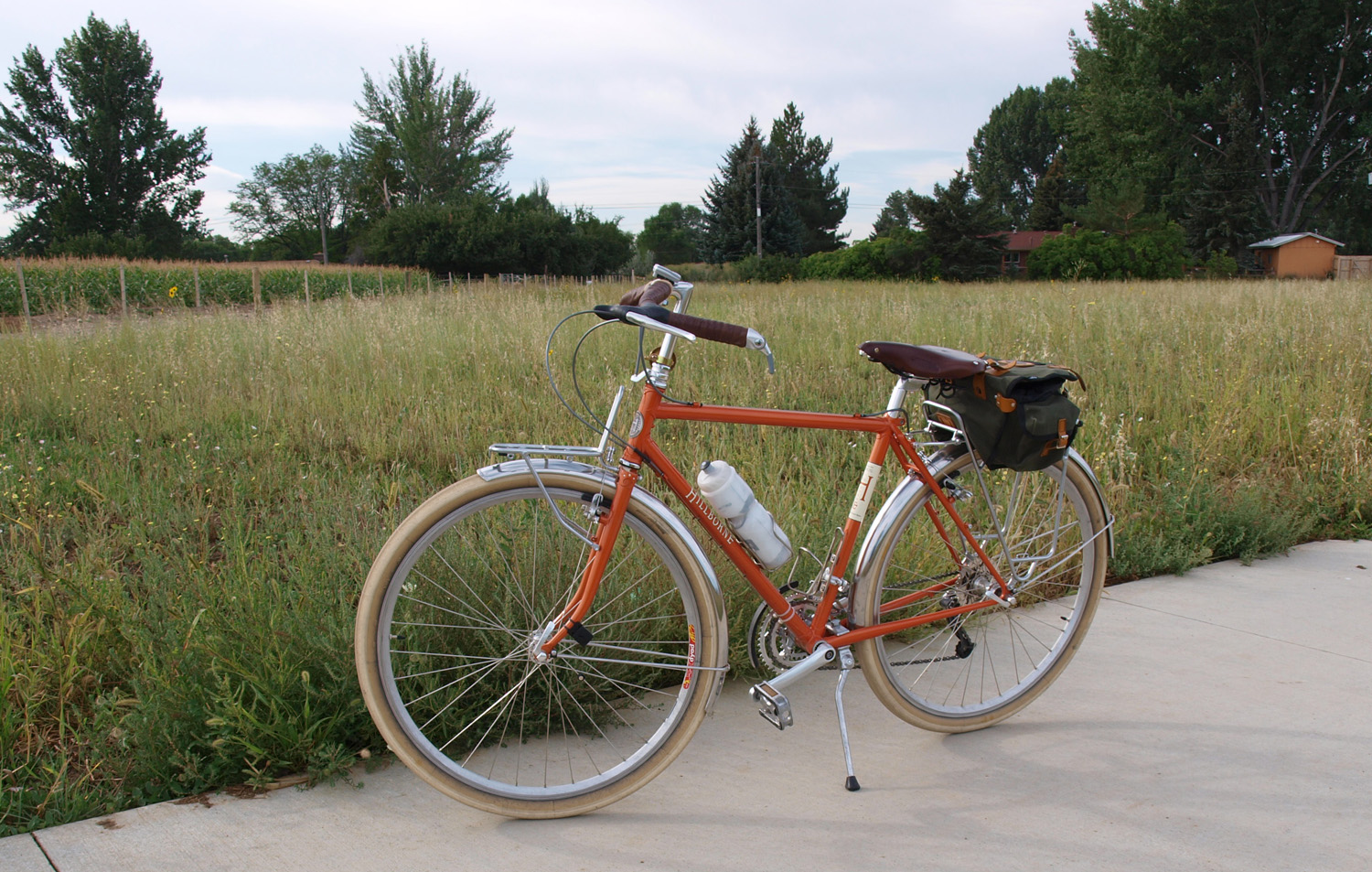
Over the past several months, I've had a few individuals contact me with various questions about the handlebars on the Sam Hillborne, so I thought perhaps a post was in order. I did write about them briefly when changes were made several months ago, but because I've had time to ride with them now, I feel a little better equipped to evaluate how they are working for me. The most common inquiry asks if they are Nitto Mustache handlebars. To put this misconception to rest, they are not. I did briefly try mustache bars, but found the stretch on a bike that's bordering on being too large for me was just too much. The handlebars are in fact Nitto Albatross bars. Before I get into it too much, if you are looking for these particular handlebars, I would advise doing some research for the lowest cost. Depending on your preference for aluminum or chromoly, I've seen price differences of up to $45 (just on new handlebars - I imagine it would be even greater on used), so there is some savings to be had if you look around.
I believe the reason that these handlebars are mistaken for mustache bars on the Hillborne is because they are mounted unconventionally (or upside down), which gives them more of a similar look to the mustache bars. Why did I do this? Well, I really didn't want to ride in a position so upright that I felt like I was on more of a city-type bicycle. I wanted to use this as a long-distance bicycle, and while the bars aren't that much lower turned upside down, I do think it provides enough that I get some lean into the handlebars. I'm sure they would work just fine mounted as intended though. Of course, these feel nothing like a drop bar on a bicycle, so the rider should be prepared for a completely different feel. While I wouldn't recommend them for those looking for extreme aerodynamics, if you're looking for an alternative that places you in a manner to see the road from a more upright position, these could do the trick.
I should point out that if your bike requires a 26.0 handlebar, from what I've found, these bars come only in a 25.4 size, which will require the purchase of a shim to make up the size difference. I have these handlebars on two bikes (the Hillborne and the Surly) which both take 26.0 bars. On the Surly, the shim was needed to make the handlebars secure, however, the Hillborne was barely able to squeeze the bars in to the stem. I don't know if it's the difference in stem types, or if I just happened to get a handlebar that was a bit larger, but I was warned that it isn't safe to ride without the shim because of the size difference, so I pass along the same to you.
One potential hazard of note is the length of the side portion of the bars. I have found that mounting these bars upside down has created a bit of a problem with "thigh strike." If I am trying to make a turn and the leg in the direction I am turning is in the up position, there is often an issue with the bar hitting my thigh making it difficult (sometimes impossible) to complete tight turns. It's particularly bothersome on this bike because it has bar end shifters and I often unintentionally move the shifters while turning. Perhaps this would be less of an issue for riders who 1) have bigger bikes, and 2) have less substantial thighs, but I suspect regardless of these two possibilities there could be an issue for other riders as well. We did remove a good portion of the end of the handlebar to help with this problem, but in reality I still need to take another inch to inch and a half off to avoid the problem completely. I don't really want to remove the handlebar tape again, so it has stopped me for the time being from doing what needs to be done. However, it is a bit unnerving when trying to take a tight turn, so I find I get off of the bike and remount after the turn to avoid any potential for a crash.
The albatross handlebars work well for both city riding and longer distances. I haven't done a tour with these handlebars, but for me I am relieved to have a position that allows my hands to be comfortable and change positions without needing the drop bars. I enjoy the positioning so much that I opted to do the same for the Surly Pacer. I haven't regretted the switch, so I do think it's possible for these handlebars to work on a variety of bikes since the Pacer has a bit more of a compact feel than the Hillborne. I will note that I don't have the same problem with "thigh strike" on the Pacer, however, we did need to remove a portion of the ends on this bike as well.  It could also be that the shifters are a part of the brake levers on this bike, or that it just has a different geometry.
Ultimately, these handlebars work for me, but hopefully this is beneficial to anyone else looking for a switch. I don't dislike drop bars, but personally I found it difficult to utilize each of the places for my hands because of the sizing on the Hillborne. For me, it was about finding comfort over long distances, and these albatross bars seem to have done the trick.

Thursday, September 8, 2011

{Part 2} The Surly Pacer: Modifications to Make it Work

The ongoing saga of the Surly Pacer set up continues, and I am finding that I do enjoy riding this bike. The changes that have taken place are definitely helping with comfort and (hopefully) with the longevity of this bike in our household. After writing about round one mods on the Pacer, I figure it's a good point to check in again.
Since the last post, the first thing to get switched out were the handlebars. While I continue to attempt to make drop bars work for me (in various forms, on different bikes), I believe that it is very near impossible for me to find comfort with any model of drops for rides longer than 10 miles or so. I am at a loss as to the why's of this, and I wish there was something scientific or even specific that I could point to as to the reason they don't work, but every time I try, it seems to be unsuccessful in the long term. So, rather than fight with it on the Pacer, I decided that a switch out to the Albatross bars might be the answer.
Somewhat surprisingly, these handlebars do seem to work well. I've been on a couple of longer rides with them and I don't return with aching hands or numb fingers. Stylistically, I think it makes the Pacer look more like a cafe racer type of bicycle than a road bike, but I've never really been one to follow the rules very well, so why should my road bike set up be any different? I have these mounted in the "unconventional" manner (flipped upside down), and it seems to work well.
The other change that has taken place is the saddle. I had mentioned that the temporary Public Bikes saddle was working in the short term, but that it wasn't a long term solution. The main reason for this is that after any sort of distance over 18-20 miles, I begin to go numb in the rear. It doesn't seem to matter if I rise up out of the saddle for a bit or not, the squishier saddle just doesn't work for long rides for my bum. I'm currently trying out a Brooks B-17 Select. While I am a Brooks fan, I have to admit that the leather on this model seems to be supremely hard (I actually knocked on it while we were adjusting it and it sounded like a woodpecker in a tree). I've never experienced this extreme on any of the wider saddles (the B-72, B-67, B-18, or B-66), so I'm prepping myself to deal with a lengthy break in process so many Brooks riders bemoan. I've proofided it up to make it as pain-free as possible, but I have a feeling that I'm in for a rocky few hundred miles (at minimum, I'm sure) to get it to a more comfortable place.
For now, these changes seem to be adequate to make the bike ride-able and comfortable. While "adequate" isn't really the word I'd like to be using, until I have more time to ride some distance, I'll refrain from shouting from the mountain tops about the glorious set up of this bike (though I do find it to be interesting and unique). As with all modifications, one change can sometimes create other issues, so I'm somewhat wary of the outcome. Stay tuned!

**A few more photos of the Pacer's set up can be found here, if interested.