Showing posts with label Surly Pacer. Show all posts

Monday, August 12, 2013

The Return {and short revised review} of the Surly Pacer

Last year, I said goodbye to my Surly Pacer. I wasn't all that sad to see it go because frankly, I felt I was getting a similar ride/function out of my Sam Hillborne. It just wasn't as fast as I'd hoped, and I saw no purpose in hanging on to an "extra" bike that may or may not get used. No love lost, I thought. We ended up trading it to a friend who was planning on building it up for his then-fiance. After their break-up, our friend was left with a frame he couldn't use. He'd tried selling it on Craigslist, and thought he had a buyer in a neighbor, but it just didn't work because she was unsure of what she would use to build it up (since it was traded as just a frame/fork/handlebar set up). Not having a plethora of "spare" bike parts (like some people, who shall remain nameless), it just seemed out of reach for her.
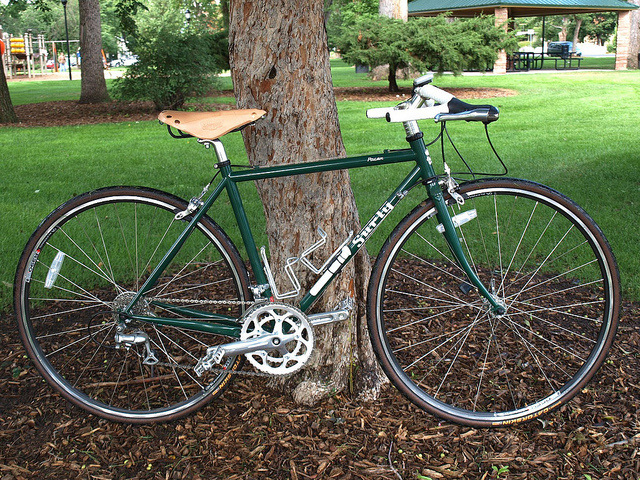
The stock Surly Pacer, minus a handlebar/saddle change
Meanwhile, as has been discussed, I've been attempting to figure out a faster/lighter road bike for myself. I've been busying myself riding the Trek Lexa SLX and attempting to get the set up right, but was finding more and more that I was fatiguing early.  I suspected that this could be due to the frame material, but having since taken the Trek on much longer rides, I don't think that was the issue at all. However, at the time of confusion, I had been looking into titanium frames and custom made steel frames, but they are a bit cost-prohibitive at the moment as we try to recover from the expense of Sam's E.R. visit. Then the light bulb went on for Sam. "Why don't we just see about getting the Surly back and putting lighter parts on it?" Sam asked. He does have his moments, I will admit, but all I could remember was the weighted feel of the ride on the Surly. I wasn't entirely convinced this was the answer. Still, being able to get a frame at no-cost (sans a promise to help out with projects around our friends' house) couldn't hurt anything. I figured that even if it didn't work out, at least we'd have parts that could be used on another frame at some point down the line.
Revised Surly Pacer
I was a bit surprised by how much the revisions made affected the feeling on this bike. I recall initially falling in love with the stock Pacer, but quickly discovering that it wasn't doing what I wanted it to do. I think the biggest fault with the bike was merely its weight. As a standard set-up the bike had heavy wheels and a steel fork. When it came back into our possession, the first thing to take place was removing the steel fork, followed by a switch to much lighter wheels.

The new-to-the-bike parts consist of a SRAM Force compact crankset, SRAM derailleurs and shifters, an older (but lighter) Shimano wheelset, a carbon seatpost, and a Reynolds Ouzo Comp fork (when I took photos, there was an Easton fork on the bike, but the steerer was cut just a bit shorter than I preferred, so it was switched out - though both forks work equally well as far as performance). It's unbelievable to me the difference the changes made to the feel and ride of the Surly. It has more pick up, it's definitely lighter, and it feels as though it was meant to be going faster out on the roads.

As for speed-to-speed comparison, I have had very similar ride times on both the aluminum Trek and the (revised) steel Surly over similar distances. In truth, I think any variance has more to do with my mental or physical state of being on any particular day than the bikes themselves.

There are many differences between the Trek and the newly revised Surly Pacer (even as far as frame geometry is concerned), but I think it's interesting that a bike that felt heavier and perhaps even a bit sluggish in its original form has the ability to be transformed into something that really could hold up on a group ride or fast paced solo ride.

In all of this, I think if someone were looking for a faster road bike, it would make sense to get the frame alone and build it up, rather than taking a stock set up from a shop (unless it was built as desired by the purchaser). As for me, the Surly probably won't be staying as part of the bike fold (the geometry creates some issues for my damaged hands), but it has been an absolute pleasure to see it transformed into a great road bike and I can see how it would be easy to love this bike again.

Monday, July 15, 2013

Bicycle "Micro Adjusters"

"It's just not right," I said to Sam as we were testing out the new build up of the recently returned to us Surly. "I can tell that there is too much pressure on my hands and that on a long ride, it's not going to work."  These sorts of conversations are quite typical, actually, in our household. We will make the smallest of changes and it's as though a whole new world opens up. Literally. We can move a saddle, handlebars, stem, millimeters (or smaller amounts) and I will experience such relief. I honestly have thought for many years that I am completely crazy and that none of the seemingly very small adjustments to my bikes were actually making a difference. That all changed on a bike shop visit a few months ago when I was informed that I am what the shop guys refer to as a "micro adjuster."
"So, basically, you're telling me that I'm a diva in regard to bicycles?" I questioned, as I jokingly threw my nose in the air and laughed. "Everything must be perfect for the queen." I was very quickly informed that this is a "real thing," and that people with these, well, let's call them sensitivities, are "paid good money" to work for bike companies to test out various aspects of a bicycle. Sweet, I thought; sign me up!  Finally, this annoying trait could bring about something good.

Although I haven't actually sought out employment with my newly discovered special "skill," it did help me understand that I am not crazy (well, at least not in that aspect of life), and that these very small shifts in seating, handlebars, brakes, and so on are actually doing something to help me find the best place for my body. In many ways though, I am still amazed that this is a reality for me.

For instance, in the conversation I started with for this post, we ended up lowering the saddle approximately 1 mm, and suddenly it was as though the pressure was fine on my hands. I was in such disbelief over it that I asked Sam to get on the bike and try it out. As he has said, we could move a lot of things on his bikes and he wouldn't even notice, and I think he had a very similar experience riding the Surly. It's difficult for me to explain how much of a difference that small change made, but I've decided that it doesn't really matter if it makes sense or not... what does matter is that finding the right fit is possible, but patience must be had (unfortunately, not always a trait I'm known for practicing). In addition, having someone with the tolerance to ride along and let me make these tiny adjustments can be challenging, but I am pretty lucky in that regard.

The biggest thing I have taken from this discovery is a lesson that I think runs across the spectrum of sensitivity: If you're not comfortable on your bike, take the time to make the adjustments (or find someone who can help you do so). After all, it's not fun to ride in pain.

Wednesday, June 26, 2013

Catching Up on Life and Bicycles

I feel as though I've gone a bit quiet here in the blogosphere. It isn't really intentional, but life has been full and busy and... well, unfortunately that means I tend to slack off on anything that requires me to sit and focus (e.g., the blog). There are things to share and they will come in time but I thought a quick post was in order for some quick updates.

On the personal/job front...
Sam has officially been offered a position locally, so it looks like we are staying here in Colorado for the time being. I think we were both a little anxious about leaving the area, but were willing to do so if needed for our survival. He is very excited about the position, the potential with the company, and as an added bonus, it's less than 10 miles from home, so he can bike a lot more frequently to work (always a nice discovery in our book).

As for Sam's health, he is doing much better after his emergency room visit. Thank you to all for your well-wishes, good thoughts and prayers. He was pretty quickly back to pedaling, running, kickboxing, etc, so I am grateful for his swift recovery.
My mock up (2-sides, anyway) of a potential switch gear box painting
A few weeks ago, I submitted a model of what I would paint on one of the several switch gear boxes around town through our local Art in Public Places program. My maquette, as well as the many others, went on display and up for public vote at the local museum, and I was informed today that I was one of the five that have been selected to paint this year. I am excited (and nervous, as it's a decent sized project), but grateful to all those who took the time to go and vote. I will do my best to take some in-progress photos as I begin working later this summer, and am looking forward to a new adventure.

On the bike front...
As some of you read here, I had put my Rivendell A. Homer Hilsen up for sale locally in an attempt to cover the out of pocket costs involved with Sam's ER visit mentioned above. Fortunately, we were able to figure out a way to get these costs covered without selling the bike, so I'm happy to report that I'm still riding him and glad to have him in the bicycle fold. I appreciate everyone who helped spread the word that the bike was for sale. I thought it would go quickly, but the universe has a way of working things out in the end, so I suppose he was meant to stay right here.
Old version of my Surly Pacer
In an odd twist, my Surly Pacer made a return to our household recently, but the only thing that remains the same is the frame and, hmm, well, that may be about it. I will attempt a post about that bike in the near future and all its fun changes (as well as more on how it ended up back here), but it was interesting to have a bike come back into the house that I assumed I would never see again. I recall that I didn't feel horribly fast on the bike before, and that has definitely changed with the modifications.

Somewhat recently, I wrote about my dilemma with a the Trek Lexa SLX. The Lexa remains in my possession for the time, thanks in part to Sam's diligence and the extension of the 30-day trial period from the bike shop. They assured me they wanted me to be comfortable and happy with the decision, and that they didn't want me to keep something I couldn't use, so I'm thrilled to report that after a much-fought decision on my part to go in for a bike fitting, the ride seems to be a lot easier on my hands (I really hate it when Sam is right). I am hoping that it remains comfortable and will be something I can keep and use regularly.

Today is bike to work day, so hopefully everyone enjoyed a peaceful ride in on his/her bicycle. Although I work from home, I did get in a lovely ride this morning and was happy to see so many out and about on two-wheels enjoying the day. It's a hot one locally, so remember to take it easy and bring extra water for the ride home. Happy riding, as always! :O)

Friday, May 11, 2012

If Loving You is Wrong, I Don't Want to be Right

{In my continuing theme of putting songs into everyone's heads}

I have recently found myself struggling with my love of the Hillborne - well, not my love of the bike itself, but the fact that I will choose him almost always over others. I have started to wonder 1) if I should have multiple bikes if I'm going to opt for him on most rides, and 2) if I have created this situation because I choose him most often when going for a ride (long or short).
About two weeks ago, I took the Surly out from the moth balls forming around him after storing him through the winter. Our first ride out together was only a few miles, but I just couldn't find comfort. I struggled through the initial ride, but couldn't grasp why I was so ill-at-ease while riding the Pacer when I had enjoyed him so much just a few months ago. What's changed? The conclusion I could come up with (as mentioned above) was that I have simply grown used to the set up on the Hillborne. I wish it were that simple for me to justify to myself, but it bothers me to some extent that I am so particular about bikes, and that I've had such a level of comfort change in a relatively short amount of time.
A few months ago, we removed the fenders, rear rack and large saddle bag from the Hillborne which lightened the load more than 10 lbs. I am aware that the majority of that weight came in the form of all of the random things I put in the larger-than-necessary saddle bag on the rear of the bike, but I was amazed at how much lighter it felt. After these changes, the weight difference between the Hillborne and the Pacer was negligible, and I found myself able to keep the same speeds on either bike. Sam and I began discussing the possibility of selling off the Pacer because I really don't want to have bikes that I'm not using.
The middle ground that we have reached is that Sam has decided to pick and choose parts to exchange on his Bianchi that were more worn out, and we are talking with a friend who is looking to build up a road bike... and so, it appears as though the Pacer may be on his way out of the house, at least in part. When I end up selling off a bike I haven't had for very long, I cannot help but feel a little sad, and a bit guilty - but of course, I don't feel great about housing bikes that aren't used either, so it always poses a dilemma for me. Do I keep it and hope that I'll find a renewed interest/comfort/etc, or do I simply set it free? I will say that having the Pacer helped me realize what I needed/wanted in a bicycle. It has helped me hone in on what makes riding enjoyable for me, and also helped me see that an increase in choices doesn't necessarily make riding better, more exciting, or speedier (necessarily). Will the Hillborne be the only bike? Unlikely. But, it is great to know that the right fit can be found, even for a persnickety individual like myself.

Have you found yourself confused about changing opinions about a particular bike you've owned (either for the good or bad)? Did/do you typically try to make changes to a bike you own, or look for a better fit on a different bike when things don't seem to be working out?

Wednesday, November 9, 2011

{Part 3} The Surly Pacer: Adjustments to Gearing

It's been a couple of months since my last check in regarding the Surly Pacer, and there have been some ongoing adjustments to this bicycle. This round has been more focused on the actual gearing of the bicycle than comfort, as I seem to have found a happy place for the time being in regard to comfort.
The Surly Pacer comes with a 34/50t crankset up front, and a 12-28t cog in the rear, making it (in my opinion) not much of a climber for steep, long hills. Originally this was intended to be my road-road bike (as opposed to the touring-road bike), so I wanted to find a way to make this a better climber. It will get up hills, but not very fast or easily (Read: Once again, G.E. is at the back of the pack going uphill, not that I necessarily mind being at the rear), particularly taking into consideration its (by my standards at least) light weight. I'm by no means an expert when it comes to proper gearing, but we quickly realized that perhaps a change was in order.

Initially, my thought was to simply get a triple crankset for the front, which would allow for more of a spinning gear, which in turn should make it easier to pedal up hills. If we changed out to the triple, however, this would mean I'd also need new shifters. We also weren't sure that the derailleur would work properly with a triple up front and we were having difficulty finding the correct bolt pattern for the crank, so instead it was decided to look for a larger tooth cog for the rear. I'm always a bit perplexed with the actual mechanics of gearing (I earn very, very low scores on those mechanical aptitude/pully tests). Why a larger tooth rear cog makes the bike easier to pedal always takes me a minute to comprehend (well, in all honesty, often more than a minute). Regardless, I just wanted to make this work, so whatever it would take was just fine by me.
Sam found an 11-34t cog for the rear, which we thought would provide enough of a difference to make the hill climbing a bit easier. Along with the new rear cog, we had to get a different rear derailleur. The only one available that would work was a different (lower level, XT) mountain bike derailleur. Sam spent many hours adjusting to get everything just right, and we went out for an initial ride to see how it would roll.
While I didn't notice much of a change initially, shifting was definitely the biggest issue with a severe lag in actual shift time. I found that I almost couldn't shift at all when on a hill because it would just click in place and not want to shift until I was at the top and on relatively flat terrain again, or it would clunk heavily into a gear when it wasn't expected, so I would end up in gears nowhere near what I needed to be in for hill climbing. It worked somewhat, but it was frustrating not to be able to change gears readily. In the end, what we believe to be the biggest issue is the mixture of parts. The front Tiagra road components want to be associated with the original rear Tiagra road components, and throwing in the XT parts just seemed to wreak utter chaos on the system.

While we could spend more time (and money) in an attempt to find a proper set up, the Pacer has really turned into more of a faster-fun-slightly-longer-ride bicycle for me. I enjoy just buzzing off quickly to a location (if I don't need to carry much - I sense a messenger bag in my future) within 15-20 miles or so, and I can always just make my legs stronger, right? In the end, I think it's a better option to keep the original set up and not mess with the design of the experts, at least not for my current needs (though part of me would like to experiment with turning it into a single speed as well). Ultimately, the Pacer is being returned to its starting point in regard to gearing because it worked its best for me in that original form. I'd rather be slow up hill, than have to get off and walk because I can't shift out of a more difficult gear, or have the system lock up entirely.

I'm certainly finding my groove with this bike and am happy that it's being used more than I initially thought it would. It's definitely fun to ride, spirited, and while I'm sure it doesn't compare to a 10 pound carbon or titanium road bike, it suits my needs quite well.

Thursday, September 8, 2011

{Part 2} The Surly Pacer: Modifications to Make it Work

The ongoing saga of the Surly Pacer set up continues, and I am finding that I do enjoy riding this bike. The changes that have taken place are definitely helping with comfort and (hopefully) with the longevity of this bike in our household. After writing about round one mods on the Pacer, I figure it's a good point to check in again.
Since the last post, the first thing to get switched out were the handlebars. While I continue to attempt to make drop bars work for me (in various forms, on different bikes), I believe that it is very near impossible for me to find comfort with any model of drops for rides longer than 10 miles or so. I am at a loss as to the why's of this, and I wish there was something scientific or even specific that I could point to as to the reason they don't work, but every time I try, it seems to be unsuccessful in the long term. So, rather than fight with it on the Pacer, I decided that a switch out to the Albatross bars might be the answer.
Somewhat surprisingly, these handlebars do seem to work well. I've been on a couple of longer rides with them and I don't return with aching hands or numb fingers. Stylistically, I think it makes the Pacer look more like a cafe racer type of bicycle than a road bike, but I've never really been one to follow the rules very well, so why should my road bike set up be any different? I have these mounted in the "unconventional" manner (flipped upside down), and it seems to work well.
The other change that has taken place is the saddle. I had mentioned that the temporary Public Bikes saddle was working in the short term, but that it wasn't a long term solution. The main reason for this is that after any sort of distance over 18-20 miles, I begin to go numb in the rear. It doesn't seem to matter if I rise up out of the saddle for a bit or not, the squishier saddle just doesn't work for long rides for my bum. I'm currently trying out a Brooks B-17 Select. While I am a Brooks fan, I have to admit that the leather on this model seems to be supremely hard (I actually knocked on it while we were adjusting it and it sounded like a woodpecker in a tree). I've never experienced this extreme on any of the wider saddles (the B-72, B-67, B-18, or B-66), so I'm prepping myself to deal with a lengthy break in process so many Brooks riders bemoan. I've proofided it up to make it as pain-free as possible, but I have a feeling that I'm in for a rocky few hundred miles (at minimum, I'm sure) to get it to a more comfortable place.
For now, these changes seem to be adequate to make the bike ride-able and comfortable. While "adequate" isn't really the word I'd like to be using, until I have more time to ride some distance, I'll refrain from shouting from the mountain tops about the glorious set up of this bike (though I do find it to be interesting and unique). As with all modifications, one change can sometimes create other issues, so I'm somewhat wary of the outcome. Stay tuned!

**A few more photos of the Pacer's set up can be found here, if interested.

Tuesday, August 30, 2011

{Part 1} The Surly Pacer: Finding a Steel Road Bike for Me

As some may have noted, I recently spoke about "another bike" that has popped up in the fold. I've avoided really discussing it for a couple of reasons. First, I needed to have some time with the new bike in order to make, at minimum, a semi-educated evaluation of its functionality, at least for my purposes. I also hesitate to talk about a bike that I'm not entirely certain I plan to keep, but at this point, it looks as though it will remain here, so it seems fair enough to talk a bit more about it.
I recently went for a long test spin on a Surly Pacer after deciding that I really wanted a lighter road bike for rides when I don't need to carry anything and I'm going out simply for exercise or general riding purposes. I'm never one to focus necessarily on speed, and I enjoyed the Pacer test ride, so it seemed like a logical choice. After the test ride, I found that I just couldn't get it out of my head. It felt quite speedy in comparison to the approximate 40 pounds I typically haul on the Hillborne, and actually reminded me of the good feelings I had when riding the hooptie bicycle from last summer. It's still not a "light bike" by roadie standards (in its current form, it weighs in at 23 lbs, without carrying an extra tube, tool, etc), and rest assured that I still fall far behind when climbing (I'm soooo not a climber!), but the fact that it feels lighter seems to help, at least somewhat, with fatigue on longer rides.
So, after hemming and hawing about whether or not I wanted to invest in another bike, I went for it. Almost immediately after purchasing the Pacer I went into a state of buyers remorse. "Why did I do this?" and "I didn't need this bike" were just a couple of the more tame thoughts that ran through my head. After all, it's difficult to justify an added expense that really wasn't a necessity. I have a bike (I have more than one bike), and I started feeling extremely guilty about spending money (which had actually been set aside for this purpose) and I felt the money could be better used for something actually needed (like fixing the backyard, which, after four months is still completely consumed by dirt and weeds... but I digress, as usual).
I rode the Pacer a few times, but not more than a few miles each trip. The first ride was only about 7 miles because things weren't adjusted properly and I didn't have the tools to make the fixes on the road. The second ride was only a bit longer, and I was short on time, so I had to head home. The next ride I intended to head out on a nice, longer ride (somewhere between 25-35 miles) to really get a feel for the bike. This number turned out to be less than 8 miles total because I was in so much pain about 4 miles into the ride that I couldn't stand it. At this point, I was feeling as though karma was turning on me, and this was revenge for spending money frivolously. When I got home, I called Sam and told him that I was selling the bike because I couldn't ride it without being in pain and there is no reason to keep a bike that causes this sort of agony.
To spare everyone needless information, I've left out several details, such as the multiple saddle changes (fortunately, they were on loan and didn't cost us), constant saddle adjustments - both height and tipping up and down, and even moving it front to back to find a "happy" spot, as well as adjusting the handlebars, brakes and so on, which is of course typical of finding comfort for anyone on a new bicycle. I was simply frustrated and really feeling down about the whole process. While I wanted to be happy with the Pacer, the bottom line is that I wasn't - at all. How could I be so comfortable on the bike during the test rides, and now find myself in such agony so quickly on rides? Something just seemed wrong.

Not allowing me to give up on this idea, Sam suggested that we continue to tweak some things. The first item to be changed was the handlebar stem. Most of my issues with bicycles (that aren't easily resolved anyway) tend to have something to do with the handlebars (the type of bar, the height, angle, etc). We swapped out the stem from Sam's Surly LHT with the stem on the Pacer, which brought the  handlebars up and closer to me so that there wasn't quite the strain on my hands. It may sound as though I purchased a frame that is too large, but in reality the smaller size is simply too small for me, causing constant strikes from my knee to the handlebars, and making me to feel like a big bear riding a much too small bicycle in a circus.
Standard Surly Pacer stem (apologies for the fuzzy photo) versus the replacement with the Surly LHT stem
As I mentioned, we had also been fiddling with the saddle, trying to come up with the right option. I tried a couple of Terry models, the original Surly saddle, and the saddle which is currently on the Pacer: the original saddle from my Public Bikes J7. It seems like an odd choice, I am aware, and it is definitely not the saddle that will remain on this bike, but out of the options thus far, it has been the most cooperative and comfortable, so it remains for the time being. It is, perhaps, a bit wider than it needs to be, but I seem to have more troubles with too narrow a saddle than too wide a saddle on this bike.
Rather than allowing me to give up on this bike, I'm glad Sam talked me into trying out more modifications. It is infinitely more comfortable than it was on the first few rides (I was able to take it on a quick 12 mile ride after the changes without issue), but after riding it during the Venus de Miles over this past weekend, I have discovered that there are limits to the length of time I can ride with the current configuration... but, hopefully that will be resolved soon. There are additional changes in store for the Pacer, which I will definitely share down the road. Basically, the plan is to use the Hillborne as a model (since it is comfortable on rides both long and short) to set the Surly up in a somewhat similar, but lighter in weight manner. I have a few parts on order, but for now, it is certainly usable and I'm enjoying getting to know the Pacer a bit better. I'm also slowly learning what types of things work for me on bicycles, and perhaps more importantly, which items don't. A lesson that seems to be ongoing for me.
**************
Post Script: I just wanted to say that in no way would I want anyone to be under the impression that the Surly Pacer is an uncomfortable bicycle. For most people, I'm certain they would find it to be a joy to ride as it is built. However, I have damage to my hands and wrists which prevents me (try as I might to deny it) from using certain set ups on a bike. This is a constant struggle for me, so learning what works and what doesn't is often a very trial and error process - sometimes with me making the same choices more than once, hoping for different results (that is the definition of insanity, right?). As with most things in life, your results would likely vary from mine. If you're looking for additional info, there is an update that can be found here.

Wednesday, August 3, 2011

Bicycle Test Ride: The Surly Pacer

The more I continue to ride my Rivendell Sam Hillborne, the easier it is to see how truly functional this bike can be for multiple purposes. If set up for the appropriate task, this bike can make a great grocery-getter, exercise bike, long-haul rider, pleasure trip companion, and the like. I grow more amazed (even after over a year of riding it) each day with its comfort and flexibility. Yesterday, I took him out on a several mile dirt/gravel path ride and was surprised at how easily I felt comfortable and stable (which is not always the case for me on unpaved roads). After changing out the handlebars, I'm happy that I don't seem to be experiencing the hand/wrist problems that I was, and it's made the ride so much more enjoyable. While it hasn't been very long since the change, I've been riding the Hillborne daily, to allow me the opportunity to get a good feel for the new set up.
All of this riding over the past few weeks has caused me to realize a couple of things about my bicycles and riding style. During this time I have found that I am more comfortable on the Hillborne than my upright bike. I don't know if it's just sheer amount of time spent on the Hillborne, or if my ride style is changing, or if it's just a temporary feeling, but I was quite disturbed to come to this conclusion.  I never thought anything would be more comfortable than sitting completely upright on a bike. How could a bike go from being so incredibly comfortable and always the number one choice, to the bike that only gets ridden a couple of miles from home?

I've also come to the realization that I actually like riding a bit faster at times. I don't have to be the slow rider all the time (though I do still enjoy this wanderer, slow sort of style), and there are instances when I wish I had the speed that isn't available when riding the Hillborne due to his set up with racks, bags, fenders, higher handlebars, and so on. This epiphany sort of moment took me on a hunt for a more road-ish style bicycle - not because I can afford another bike, nor that I will be buying another bike any time soon, but because I really wanted to see what it felt like to have a bit more of a road set up.
The closest thing I've been on in adulthood that was some form of a road bicycle (except for my test rides of bikes just before purchasing the Hillborne frame) was the old Raleigh Super Course MK2, which was actually too large for me. When we had obtained this bicycle, I was a little afraid of it and its ability for speed. After some time on the Hillborne, I thought perhaps I would feel differently. My criteria was fairly loose, but I had some requests. 1) That the bicycle be relatively simple (meaning not a lot of extras on it); 2) a steel frame and probably fork too; and 3) something that could be attainable if "extra" (as if there's ever extra) money was available.
**Image from Pedal Revolution
After some research on geometry/specs, and looking up reviews, I decided to try out a Surly Pacer. As a wonderful treat, I was able to take it on a pretty decent ride, thanks to the folks at Salvagetti in Denver (who, by the way for anyone in the area, I've had great experiences with - the people are nice, they'll explain things that need explanation, and they don't make you feel like a moron for asking "stupid" questions). I was a bit tentative at first because I'm used to riding on some fairly wide tires (42cm) versus the thinner tires (28cm) on the Pacer. But within a few pedal strokes I was off and moving like nothing would stop me. I was surprised at how quickly I was comfortable on this bike, considering a year ago I would've freaked out if the handlebars were any less than 6 inches above the saddle. The ride was smooth and it shifted with ease. I hadn't actually tried STI shifters prior to this ride, but they are surprisingly intuitive, and I can see how they would become a "must have" for road riders.
**Image from Shimano
One of the other aspects that I like about the Pacer's possibilities is that a buyer can purchase the frame and fork alone, or the entire bike as a whole. In the past, Surly has only sold the Pacer as a fork/frame combo, but recently decided to also sell it as a whole bike. I think this provides people with options such as buying the frame and fork, while saving up for the parts, or being able to put higher end parts on the frame if one desires.  Also, if you're not someone who wants to have to think about what would work on the bike, you can buy it ready to ride (sans pedals - and you'll likely want to change the saddle as well as Surly isn't known for putting the best saddles on their bikes).
**Image from Surly
Aesthetically, this bike is not one that really speaks to me (I have to face facts that I'm an artist and I can't help but notice the looks of any bike I see). The British Racing Green color that is currently produced isn't my personal favorite, but I've seen far worse colors on a bike, so it's certainly doable. At least it's fairly neutral and doesn't stand out like a neon color would, and I think with the right bar tape and perhaps saddle color change, it could be decent. There are no beautiful lugs to drool over, and there's nothing that screams "this bike is special" to me as far as looks go... but sometimes, I will admit, functionality has to win out over looks.

Still, even as I sit here typing, I find myself thinking about the Pacer quite fondly, so there's obviously something about it that can draw a rider to it. For anyone in the market for a steel road bike, I think the Pacer is definitely an option to check out. You just might find yourself falling in love.